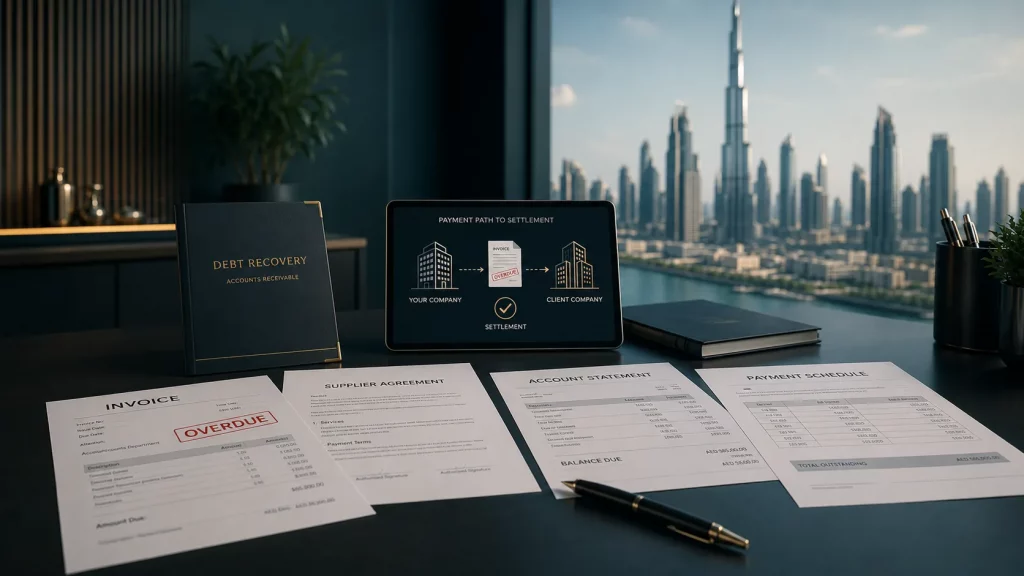
Commercial debt collection is the process of recovering overdue payments owed by one business to another. It may involve unpaid invoices, supplier balances, trade credit, service fees, construction payments, commercial rent or other contractual B2B obligations.
The collection of commercial debt normally begins with account verification and direct payment reminders. If internal follow-up fails, the creditor may use professional negotiation, a commercial debt collection agency, a formal legal notice or court or arbitration proceedings, depending on the contract and circumstances.
For the strongest recovery position, businesses should act early, identify the correct debtor, preserve evidence and select an escalation method based on recoverability, not just the amount owed.
What Is Commercial Debt?
Commercial debt is an unpaid financial obligation arising from a business transaction.
Common examples include:
- Unpaid supplier invoices
- Overdue consultancy fees
- Construction and subcontractor payments
- Logistics and shipping charges
- Recruitment fees
- Marketing and agency retainers
- Commercial rent
- Wholesale and distribution balances
- Trade-credit accounts
- Equipment-hire charges
- Outstanding corporate service fees
- Contractually due milestone payments
A debt does not become stronger merely because an invoice was issued. The creditor should also be able to demonstrate the underlying agreement, supply, performance, and due date.
Outstanding Corporate Payments Affecting Your Cash Flow?
Share the debt amount, invoice age, debtor location, and available documents for an initial assessment.
Recover Outstanding Corporate Debts Without Disrupting Your Business
Quick Action helps businesses recover unpaid corporate invoices and overdue accounts through document assessment, professional debtor communication, settlement negotiation and structured escalation when required.
Explore Corporate Debt Collection ServicesCommercial Debt Collection Versus Consumer Collection
| Commercial debt | Consumer debt |
| Owed in a business transaction | Owed for personal or household purposes |
| Usually business-to-business | Usually business-to-consumer or lender-to-consumer |
| Based on contracts, invoices and trade terms | Often based on consumer loans or service agreements |
| May involve complex supply chains | Usually involves an individual customer |
| Frequently higher in value | Value varies |
| Can include arbitration or commercial courts | Consumer regulations may be more prominent |
| Focuses on receivables and business cash flow | Focuses on personal repayment obligations |
This article focuses on B2B and corporate debt collection. Consumer loan, credit-card and personal-debt cases may be subject to different regulatory requirements.
What Is the Commercial Debt Collection Lifecycle?

Commercial debt recovery usually moves through four stages.
1. Internal credit control
The creditor’s finance or accounts-receivable team:
- Confirms the invoice
- Resolves administrative issues
- Sends reminders
- Calls the customer
- Requests a specific payment date
- Escalates the account internally
This stage is most suitable when the account is recent and the customer remains responsive.
2. Professional pre-legal collection
A commercial debt collection agency may:
- Review the account
- Contact the debtor
- Confirm whether the balance is disputed
- Negotiate payment
- Structure an instalment plan
- Document payment commitments
- Recommend further escalation
The creditor generally retains ownership of the debt unless a separate assignment or sale has taken place.
3. Legal assessment and proceedings
When amicable collection fails, an authorised lawyer may assess:
- Strength of the evidence
- Correct jurisdiction
- Governing law
- Arbitration clauses
- Limitation issues
- Payment-order eligibility
- Court costs
- Debtor assets
- Enforcement prospects
4. Judgment or award enforcement
If the creditor obtains an enforceable judgment or arbitral award, recovery proceeds through the competent legal enforcement framework. A debt collection agency cannot independently freeze accounts, seize assets, or issue judicial orders.
Step-by-Step Commercial Debt Collection Process in the UAE

Step 1: Identify the correct debtor
Confirm the exact legal entity that entered the transaction.
Check:
- Company name on the contract
- Trade-licence details
- Branch or parent-company status
- Purchase-order issuer
- Invoice recipient
- Registered address
- Signatory’s authority
- Any personal or corporate guarantee
A brand name, branch, free-zone entity and mainland company may be legally distinct. Pursuing the wrong entity can delay or undermine recovery.
Step 2: Reconcile the account
Verify:
- Total principal balance
- Invoice numbers
- Due dates
- Credits and returns
- Partial payments
- Contractual deductions
- Retention amounts
- Claimed interest or penalties
- Currency
- Any counterclaim
The statement of account should match the amount demanded.
Step 3: Assemble the evidence
Create one recovery file containing:
| Document | Purpose |
| Contract or accepted quotation | Establishes terms |
| Purchase order | Shows the debtor ordered the supply |
| Invoices | Shows amounts and due dates |
| Statement of account | Summarises the balance |
| Delivery notes | Supports delivery of goods |
| Completion certificates | Supports completion of work |
| Timesheets or service reports | Supports performance |
| Emails and messages | May show instructions or acceptance |
| Payment records | Shows prior and partial payments |
| Debt acknowledgement | Confirms the debtor accepts the amount |
| Previous reminders | Records collection efforts |
| Settlement documents | Records revised obligations |
Electronic evidence can be relevant under the UAE Law of Evidence, subject to admissibility and the facts of the case. UAE Law of Evidence
Step 4: Determine whether the debt is disputed
Ask the debtor to state in writing:
- Whether the full debt is disputed
- Which invoices are disputed
- The amount challenged
- The contractual basis
- The supporting documents
- The proposed resolution
If only part of the account is disputed, request payment of the undisputed portion.
Step 5: Send a structured payment demand
A commercial payment demand should include:
- Creditor’s legal name
- Debtor’s legal name
- Contract or account reference
- Invoice numbers
- Total amount due
- Original payment dates
- Payment instructions
- Final response date
- Contact for resolving a genuine dispute
- Accurate description of possible next steps
Use a firm, factual tone. Do not make threats or claim that legal action has begun when it has not.
Step 6: Negotiate payment
Where the debtor acknowledges the debt, possible solutions include:
- Immediate payment in full
- Upfront partial payment
- Fixed instalments
- Revised payment date
- Settlement of multiple invoices
- Waiver of a disputed component
- Full-and-final settlement
Any arrangement should be documented.
A payment plan should define:
- Acknowledged balance
- Instalment amounts
- Due dates
- Payment method
- Consequences of default
- Treatment of interest or costs
- Whether previous rights remain preserved
- When account clearance will be provided
Step 7: Appoint a commercial debt collection agency
External collection becomes appropriate when:
- Internal reminders have failed
- The debtor ignores communication
- Payment promises are repeatedly broken
- The account is consuming management time
- The creditor wants to preserve the relationship
- The debtor is in another emirate or country
- Several overdue accounts require coordinated collection
- The business lacks internal credit-control resources
Step 8: Escalate legally where justified
Legal action may be appropriate when:
- The debt is sufficiently documented
- The debtor refuses to engage
- The dispute cannot be resolved
- A settlement agreement has been breached
- Assets or evidence may disappear
- The financial position is deteriorating
- The amount justifies the likely costs
- A contractual or legal deadline is approaching
Depending on the claim, the available route may involve a payment order, commercial claim or arbitration.
The UAE Commercial Transactions Law governs many B2B transactions, while the Civil Procedure Code covers court procedures and enforcement. Commercial Transactions Law and Civil Procedure Code
Undisputed Versus Disputed Commercial Debt
| Undisputed commercial debt | Disputed commercial debt |
| Debtor accepts the balance | Debtor challenges liability or amount |
| Main problem is non-payment | Main problem is contractual disagreement |
| Collection agency may be effective | Legal or technical assessment may be required |
| Payment plan may resolve the case | Evidence reconciliation may be necessary |
| Broken promises support escalation | Generic chasing may deepen the dispute |
| Written acknowledgement is valuable | Expert reports may be relevant |
A collection agency can communicate and negotiate, but it does not decide whether a contractual dispute is legally valid.
Internal, Agency and Legal Recovery Compared
| Recovery method | Best used when | Main advantage | Main limitation |
| Internal credit control | Debt is recent and debtor responsive | Low external cost | Uses staff time |
| Collection agency | Internal follow-up has failed | Independent structured pressure | Cannot issue judgments |
| Lawyer-led recovery | Debt is disputed or legally complex | Legal analysis and formal representation | Higher cost and formality |
| Court or arbitration | Amicable efforts have failed | Can produce an enforceable decision | Time, cost and enforcement risk |
The strongest option is not always the most aggressive option. The objective is to select the route most likely to produce a commercially sensible recovery.
When Should You Hire a Commercial Debt Collection Agency?
Consider external support when:
- The balance is materially affecting cash flow
- More than one invoice is overdue
- The debtor avoids the finance team
- Payment dates repeatedly pass
- Management intervention has failed
- The debtor is outside the creditor’s normal reach
- The account requires consistent multilingual contact
- The business wants to avoid immediate litigation
- Internal collection costs are becoming excessive
Do not wait solely for an invoice to reach a particular age. A recent debt from a business that is closing may require faster action than an older debt from a solvent and cooperative customer.
Quick Action can manage debtor communication, payment negotiations and structured escalation while helping protect your commercial relationships.
Recover Outstanding Corporate Debts Without Disrupting Your Business
Quick Action helps businesses recover unpaid corporate invoices and overdue accounts through document assessment, professional debtor communication, settlement negotiation and structured escalation when required.
Explore Corporate Debt Collection ServicesWhat Should a Commercial Collection Agency Do?
A professional agency should:
- Review the case documents.
- Confirm the debtor’s identity.
- Reconcile the balance.
- Identify whether the debt is disputed.
- Establish a contact strategy.
- Communicate professionally.
- Report debtor responses.
- Obtain creditor approval before material settlement.
- Document commitments and payments.
- Explain when legal referral may be appropriate.
The agency should also explain its fee model, reporting process, settlement authority and handling of recovered funds before appointment.
Can Commercial Debt Be Recovered Without Court Action?

Yes. Many business debts are resolved through:
- Direct payment after third-party contact
- Account reconciliation
- Immediate partial payment
- Instalment agreements
- Mediated negotiation
- Settlement of disputed invoices
- Written acknowledgement followed by scheduled payments
Amicable recovery can reduce cost and preserve business relationships. It should not, however, become an indefinite cycle of unfulfilled promises.
When Is Legal Action Worth Considering?
Assess legal action using five questions:
- Can the debt be proved?
Review the contract, performance evidence and amount. - Is the correct party identifiable?
Confirm the debtor and any guarantor. - Does the debtor have recoverable assets or income?
A judgment has limited commercial value if it cannot be enforced. - Which forum has jurisdiction?
Review court, free-zone and arbitration clauses. - Are the likely costs proportionate?
Compare claim value, fees, time and enforcement prospects.
Legal action should be a commercial decision supported by legal advice—not a reaction to frustration.
International Commercial Debt Recovery
Cross-border B2B recovery requires additional checks:
- Governing law
- Jurisdiction
- Debtor’s country
- Asset location
- Currency
- Language and translation
- Service requirements
- Recognition of judgments
- Arbitration provisions
- Local collection and legal costs
A UAE creditor may need to pursue a foreign debtor where its assets are located. Conversely, an international supplier seeking payment from a UAE company may benefit from a UAE-based collection strategy before beginning proceedings.
How to Choose a Commercial Debt Collection Partner
Ask potential providers:
- Do you specialise in B2B debt?
- Do you operate in the debtor’s jurisdiction?
- Which industries do you understand?
- How are fees calculated?
- Are there administration or legal costs?
- Who approves settlements?
- How often are updates provided?
- Where are recovered funds paid?
- What happens if recovery is unsuccessful?
- How is legal work referred and authorised?
- Can you manage one debt and debt portfolios?
- How is confidential business information protected?
Avoid choosing solely on the lowest fee. Relevant experience, transparency, documentation and geographic capability may have greater commercial value.
Preventing Future Commercial Debt
Businesses can reduce overdue accounts by:
- Conducting customer credit checks
- Identifying the correct contracting entity
- Using written contracts
- Setting clear credit limits
- Requesting deposits
- Using milestone billing
- Defining acceptance procedures
- Obtaining delivery confirmation
- Invoicing promptly
- Monitoring aged receivables
- Following up before due dates
- Pausing further credit when accounts become overdue
- Reviewing repeated late-payment behaviour
Commercial Debt Recovery Support from Quick Action
Quick Action supports UAE and international businesses with structured commercial debt collection, including document review, debtor communication, payment negotiation, settlement coordination and cross-border recovery.
Where formal proceedings become necessary, the matter can be assessed and referred through the appropriate authorised legal channel.
Are outstanding business debts affecting your cash flow? Contact Quick Action for an initial commercial debt assessment.
Recover Outstanding Corporate Debts Without Disrupting Your Business
Quick Action helps businesses recover unpaid corporate invoices and overdue accounts through document assessment, professional debtor communication, settlement negotiation and structured escalation when required.
Explore Corporate Debt Collection ServicesCommercial Debt Collection – FAQ
What is commercial debt collection?
Commercial debt collection is the recovery of money owed from one business to another. It commonly involves unpaid invoices, supplier accounts, service fees, trade credit and contractual payments.
What is an example of commercial debt?
A supplier delivers AED 50,000 of goods to a corporate customer under 30-day payment terms, but the customer does not pay by the due date. The unpaid supplier balance is commercial debt.
What is the difference between commercial and corporate debt collection?
Commercial debt collection covers debts arising from business transactions generally. Corporate debt collection usually refers to recovering debts involving incorporated companies, often with larger balances or more complex structures.
Is commercial debt collection the same as B2B debt collection?
The terms are commonly used interchangeably. Both generally describe recovery of debts owed between businesses rather than personal consumer debts.
What documents are required for commercial debt recovery?
Useful documents include contracts, purchase orders, invoices, statements of account, delivery notes, completion certificates, emails, payment records and written acknowledgements.
Can a commercial debt be recovered without a signed contract?
Potentially. Purchase orders, accepted quotations, invoices, delivery documents, emails, messages, payment history and conduct between the parties may help establish the obligation.
How long should a business wait before escalating a debt?
A business should begin follow-up as soon as payment becomes overdue. Escalation should be based on the debtor’s response, financial risk, strength of evidence and commercial impact rather than one universal waiting period.
Can a debt collection agency take a company to court?
A collection agency cannot issue a judgment. If legal action is appropriate, the creditor may instruct an authorised lawyer, and the agency may coordinate the referral.
Can disputed commercial debt be sent to collection?
Yes, but a collection agency cannot determine the legal merits of a genuine contractual dispute. Complex disputes may require legal assessment, mediation, arbitration or court proceedings.
How are commercial debt collection fees calculated?
Models may include a success-based percentage, fixed fee, hourly fee or a combination. Fees can vary according to debt age, value, location, complexity and whether legal action is required.
Can international commercial debts be recovered?
Yes, but recovery depends on the contract, governing law, jurisdiction, debtor location, available assets and cross-border enforcement options.