
An overdue invoice is not just a delayed payment — it is a cash flow risk, a solvency warning, and sometimes the first sign of debtor distress.
If your business is facing:
• Repeated broken payment promises
• International clients delaying without explanation
• Growing receivables impacting working capital
• Concerns about a debtor’s financial stability
• Silence after multiple follow-ups
You are no longer dealing with an accounting issue. You are facing an enforcement decision.
Many businesses wait too long — hoping the relationship will self-correct. During that delay, leverage weakens, limitation periods approach, and distressed debtors prioritise banks and secured creditors over trade suppliers.
This guide explains:
• Your legal rights in the UAE, UK, US and internationally
• Whether you can charge late payment interest and compensation
• How limitation periods affect your recovery
• When escalation becomes commercially necessary
• What structured unpaid invoice recovery involves
• How cross-border enforcement works
• When early intervention materially increases recovery probability
We also outline how a coordinated, enforcement-aware approach reduces risk — especially when financial indicators such as deteriorating Debt Service Coverage Ratio (DSCR) suggest declining repayment capacity.
If your receivables are at risk, contact us today for a confidential debt recovery assessment and structured international recovery strategy.
Unpaid invoices require structure, timing, and jurisdictional clarity.
The objective is not aggressive action — it is maximising recovery probability while protecting commercial positioning.
What Is Unpaid Invoice Recovery?

Unpaid invoice recovery is the structured legal and commercial process of collecting overdue business payments through formal demand, escalation, and enforcement. It goes beyond reminders. It combines leverage strategy, legal positioning, jurisdiction analysis, and cross-border coordination to maximise recovery while reducing delay and asset dissipation risk.
For CFOs, exporters, and SMEs, unpaid invoices are not accounting issues — they are enforcement risks.
Why Unpaid Invoices Become a Financial Threat
Most businesses underestimate the speed at which overdue invoices evolve into unrecoverable debt.
1. Cash Flow Disruption
• Delayed receivables impact working capital
• Increased borrowing costs
• Reduced DSCR (Debt Service Coverage Ratio)
• Supplier payment chain reaction
2. Debtor Prioritisation Risk
When companies experience financial pressure, payment priority typically follows:
- Secured lenders
- Government obligations
- Employees
- Key operational suppliers
- Unsecured trade creditors (often last)
If you are an unsecured creditor, delay reduces leverage.
3. Limitation Period Exposure
Every jurisdiction imposes time limits to pursue a claim. Waiting too long may permanently extinguish legal rights.
4. Asset Dissipation Risk
Once a debtor anticipates enforcement:
• Funds may be transferred
• Assets restructured
• Company may enter restructuring or insolvency
Early structured intervention materially increases recovery probability.
Recovery Escalation Framework
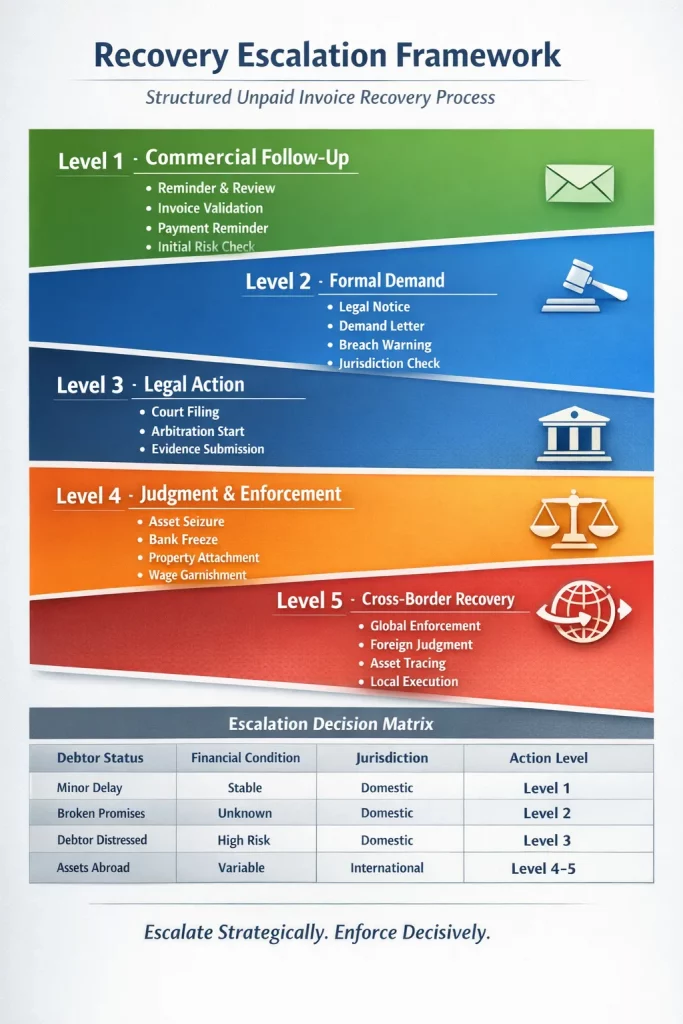
Unpaid invoice recovery should follow a disciplined escalation model. Each level increases legal pressure, strengthens enforceability, and protects creditor positioning — while controlling cost and procedural risk.
Level 1 — Controlled Commercial Engagement
Objective: Secure voluntary payment without triggering premature litigation.
Actions:
• Contract and invoice validation
• Payment reminder aligned with agreed terms
• Reconfirmation of delivery/acceptance
• Clarification of payment deadline
• Interest positioning (where legally applicable)
• Initial debtor financial risk review
Trigger to Escalate:
• No response within 7–14 days
• Repeated broken promises
• Evasive communication
Risk if Delayed:
• Creditor perceived as low priority
• Leverage erosion
• Asset movement risk begins
Level 2 — Formal Demand & Legal Positioning
Objective: Shift matter from operational delay to legal exposure.
Actions:
• Structured demand letter
• Statutory interest reference (UK, if applicable)
• Contractual breach notice
• Pre-action compliance (UK protocols)
• Jurisdiction clause confirmation
• Escalation deadline with consequences
Trigger to Escalate:
• Continued non-payment
• Formal refusal
• Dispute raised without merit
• Financial distress indicators emerging
Risk if Delayed:
• Limitation period pressure
• Debtor reprioritises secured creditors
• Negotiation leverage weakens
Level 3 — Legal Proceedings Initiation
Objective: Obtain enforceable legal decision.
Actions May Include:
• Filing claim in competent court (UAE / UK / US)
• Arbitration initiation (if contractually required)
• Evidence consolidation
• Procedural compliance
• Interim protective measures (where available)
Strategic Considerations:
• Debtor solvency
• Asset location
• Jurisdiction efficiency
• Enforcement feasibility
Key Principle:
Litigation is not the goal. Enforceability is.
Level 4 — Judgment & Domestic Enforcement
Objective: Convert judgment into payment.
Enforcement Tools (Jurisdiction Dependent):
• Bank account attachment
• Asset seizure
• Garnishment (US states)
• Charging orders (UK)
• Execution proceedings (UAE courts)
• Third-party debt orders
Risk if Delayed:
• Asset dissipation
• Corporate restructuring
• Insolvency filing
Level 5 — Cross-Border Recognition & Execution
Objective: Enforce where assets are located internationally.
May Require:
• Recognition of foreign judgment
• Enforcement under New York Convention (arbitration awards)
• Local enforcement proceedings
• Treaty compliance analysis
• Asset tracing coordination
Complexity Level: High
Timing Sensitivity: Critical
Cross-border recovery must be structured from the outset.
International Legal Framework Comparison

Unpaid invoice recovery varies significantly by jurisdiction. Below is a high-level comparison for commercial creditors.
| Factor | UAE | UK | US (General) | International (Cross-Border) |
|---|---|---|---|---|
| Interest on Late Payment | Court discretion or contractual | Statutory under Late Payment Act 1998 (8% + base rate) | Contract-based or state law | Depends on governing law |
| Limitation Period | Typically 3–15 years depending on claim type | Generally 6 years (contract claims) | Varies by state (3–6+ years common) | Based on governing law |
| Pre-Action Protocol | Not mandatory in same way as UK | Required in many commercial claims | Varies by state | Depends on jurisdiction |
| Enforcement Complexity | Moderate | Structured but procedural | State-based | High without treaty |
| Foreign Judgment Recognition | Possible under treaty or reciprocity | Yes under recognition framework | Depends on state | Requires legal recognition process |
Important: Jurisdiction clauses in contracts heavily influence enforcement strategy.
When Immediate Recovery Action Is Critical
Businesses should consider structured unpaid invoice recovery when:
• Invoice overdue beyond agreed terms
• Debtor stops responding
• Payment plans repeatedly breached
• DSCR or financial indicators show distress
• Debtor entering restructuring discussions
• International debtor delaying without explanation
Delay reduces leverage.
Authority Positioning
Quick Action is a UAE-based commercial debt recovery coordination firm specialising in:
• International unpaid invoice recovery
• Pre-legal structured recovery
• Enforcement support
• Cross-border coordination
We operate within applicable legal frameworks while aligning escalation strategy with commercial objectives.
Late Payment Legislation & Legal Rights (UAE, UK, US)
Unpaid invoice recovery is governed by contract law and statutory frameworks. Your ability to charge interest, recover compensation, or escalate to court depends on jurisdiction and contract wording. Understanding this before escalation prevents procedural mistakes and strengthens leverage.
United Kingdom – Late Payment of Commercial Debts Act 1998
In the UK, businesses are protected under the Late Payment of Commercial Debts (Interest) Act 1998.
Creditors can claim:
• Statutory interest (8% above Bank of England base rate)
• Fixed compensation (£40–£100 depending on invoice value)
• Reasonable recovery costs beyond fixed compensation
Interest accrues automatically in qualifying B2B transactions, unless contract terms specify otherwise.
This significantly increases negotiation leverage.
United Arab Emirates – Commercial & Civil Framework
In the UAE, unpaid invoice recovery is governed by:
• Federal Decree-Law No. 42 of 2022 (Civil Procedures Law)
• UAE Commercial Transactions Law
• UAE Civil Code
Key points:
• Interest must generally be contractual or court-awarded
• Courts may apply commercial interest rates
• Limitation periods vary depending on claim type
• Enforcement is execution-driven after judgment
Unlike the UK, statutory late payment compensation is not automatic.
United States – State-Based Contract Framework
In the US:
• Interest depends on contract terms
• State statutes govern prejudgment interest
• Limitation periods vary by state
• Enforcement tools differ by jurisdiction
There is no federal “Late Payment Act” equivalent for commercial invoices.
Can You Charge Interest on Overdue Invoices?
Interest rights vary significantly by jurisdiction.
Below is a practical comparison.
| Jurisdiction | Statutory Interest Available | Compensation Fees | Contract Required? | Notes |
|---|---|---|---|---|
| UK | Yes – 8% + base rate | Yes (£40–£100) | Not strictly | Applies to qualifying commercial debts |
| UAE | Court discretion or contract | No statutory fixed fee | Recommended | Contract clarity critical |
| US | State-based | No fixed statutory fee | Yes (usually) | Varies by state |
| International | Depends on governing law | Depends | Yes | Contract clause decisive |
Practical insight:
Where contracts are silent, recovery leverage may weaken — especially in cross-border transactions.
How Long Can a Company Chase a Debt?
Limitation periods are critical. If expired, the debtor may legally refuse payment.
| Jurisdiction | Typical Limitation Period (Contract Claims) | Risk if Delayed |
|---|---|---|
| UK | 6 years | Claim becomes statute-barred |
| UAE | Often 3–15 years depending on claim type | Procedural defence by debtor |
| US | 3–6 years common (state dependent) | Dismissal if filed late |
| International | Based on governing law | Enforcement barred |
Note: Acknowledgment of debt or part-payment may reset limitation in some jurisdictions.
Delay creates irreversible risk.
Unpaid Invoice Recovery Timeline: How Long Will Recovery Take?
Below is a structured commercial estimate.
| Stage | Estimated Duration | Risk Level | Escalation Trigger |
|---|---|---|---|
| Commercial Reminder | 7–14 days | Low | No response |
| Formal Demand | 14–21 days | Moderate | Continued non-payment |
| Pre-Legal Notice | 14–30 days | Increasing | Refusal or dispute |
| Legal Proceedings | 2–8 months (jurisdiction dependent) | High | Formal claim filed |
| Enforcement | 1–6+ months | Asset dissipation risk | Judgment obtained |
| Cross-Border Enforcement | 3–12+ months | High procedural risk | Assets abroad |
Important:
Time increases significantly when assets are outside the originating jurisdiction.
Early intervention shortens overall recovery cycle.
Cross-Border Legal Considerations
International unpaid invoice recovery introduces additional layers:
• Governing law clause
• Jurisdiction clause
• Arbitration clause
• Service of process rules
• Recognition of foreign judgments
• Treaty application
Where contracts lack jurisdiction clarity, procedural complexity increases.
International Enforcement Pathway
[Visual Placeholder – Cross-Border Enforcement Flow]
Description of visual:
- Contract Review
- Jurisdiction Determination
- Legal Filing
- Judgment
- Recognition Abroad
- Asset Execution
This visual clarifies that international recovery requires coordination beyond domestic filing.
Risk Indicators That Escalation Should Not Be Delayed
Commercial creditors should escalate when:
• Debtor DSCR falls below 1
• Payment patterns deteriorate
• Multiple suppliers unpaid
• Credit insurance triggers activated
• Insolvency rumours emerge
• Cross-border asset movement suspected
Waiting for “goodwill resolution” during financial distress reduces recovery likelihood.
Where Structured Recovery Outperforms Informal Chasing
Unstructured chasing often leads to:
• Repeated broken payment promises
• Loss of limitation period awareness
• Weak legal leverage
• Inability to enforce internationally
Structured unpaid invoice recovery integrates:
• Legal positioning
• Timing strategy
• Jurisdiction analysis
• Enforcement readiness
This materially improves recovery probability.
When Is Unpaid Invoice Recovery Commercially Justified?
Unpaid invoice recovery should be assessed strategically — not emotionally. The correct question is not “Should we chase this?” but “Is structured escalation economically rational given debtor condition, jurisdiction, and asset position?”
A structured evaluation reduces sunk-cost risk and increases recovery probability.
Cost vs Recovery Decision Matrix
Below is a commercial escalation model used in cross-border invoice recovery planning.
| Invoice Value | Debtor Financial Condition | Jurisdiction Complexity | Recommended Action |
|---|---|---|---|
| Low (< £5k / $6k) | Stable | Domestic | Structured pre-legal recovery first |
| Medium (£5k–£50k / $6k–$60k) | Uncertain | Domestic | Demand + timed legal escalation |
| Medium | Distressed (DSCR < 1) | Domestic | Immediate legal review |
| High (£50k+) | Stable | Cross-border | Strategic leverage + asset review |
| High | Distressed | Cross-border | Early enforcement strategy |
| Any | Insolvency imminent | Any | Immediate protective action |
Key principle:
The more distressed the debtor, the earlier escalation should occur.
Insolvency Risk & Recovery Timing
When a debtor shows financial distress indicators, unsecured creditors face priority risk.
Typical payment hierarchy in distress:
- Secured lenders
- Government liabilities
- Employees
- Critical operational vendors
- Trade creditors
If a debtor enters formal insolvency:
• Recovery often drops significantly
• Claims may be diluted
• Litigation leverage disappears
• Creditors compete for limited assets
Early structured action preserves positioning.
DSCR as a Warning Signal (Bridge Section)
Debt Service Coverage Ratio (DSCR) measures a company’s ability to service its debt obligations from operating income.
DSCR below 1 typically indicates:
• Cash flow insufficient to cover debt
• Increased risk of missed loan payments
• Deferred supplier payments
• Liquidity stress
For creditors, deteriorating DSCR is not an academic metric — it is a recovery timing signal.
When DSCR declines:
• Debtor prioritises banks
• Trade creditors move down the list
• Payment delays increase
• Insolvency probability rises
This is often the optimal moment for structured unpaid invoice recovery intervention.
Signs You Should Engage Professional Recovery Immediately
Businesses should consider structured escalation when:
• Payment delay exceeds 30–60 days beyond terms
• Debtor disputes without evidence
• Payment plans repeatedly breached
• Debtor restructures or changes corporate structure
• International jurisdiction involved
• Financial indicators deteriorate
• Communication becomes evasive
The longer recovery is delayed during distress, the lower the probability of full recovery.
Commercial Advantages of Structured Recovery vs Internal Chasing
| Internal Chasing | Structured Recovery Model |
|---|---|
| Emotional communication | Legally calibrated positioning |
| Inconsistent follow-up | Escalation timeline discipline |
| No jurisdiction analysis | Contract + governing law review |
| No enforcement planning | Enforcement-ready approach |
| No asset tracing | Financial feasibility assessment |
Unstructured chasing often weakens future legal leverage.
International Unpaid Invoice Recovery Strategy
Cross-border recovery requires:
• Contractual clause analysis
• Jurisdiction validation
• Enforcement treaty review
• Local procedural compliance
• Asset location intelligence
Quick Action coordinates:
• UAE-based commercial recovery
• UK & US escalation pathways
• Arbitration enforcement (where applicable)
• Foreign judgment recognition
• Asset tracing support
International recovery is procedural. It must be structured from the outset.
Enforcement Complexity by Scenario
| Scenario | Recovery Complexity | Risk Level | Recommended Timing |
|---|---|---|---|
| Domestic debtor, responsive | Low | Moderate | Structured demand |
| Domestic debtor, non-responsive | Medium | Rising | Legal review |
| International debtor, responsive | Medium | Moderate | Controlled escalation |
| International debtor, non-responsive | High | High | Immediate structured action |
| Debtor restructuring | Very High | Severe | Urgent protective action |
Delay increases complexity.
When to Engage a Commercial Debt Recovery Agency
Engagement a commercial debt recovery is justified when:
• Internal follow-up fails
• Legal escalation required
• Cross-border enforcement involved
• Insolvency risk detected
• High-value invoices at risk
• Contract ambiguity requires legal positioning
Early engagement often reduces total recovery time and cost.
Structured Recovery Authority Positioning
Quick Action operates as:
• UAE-based commercial recovery coordination firm
• International enforcement-aware
• Compliance-driven
• Escalation-structured
We integrate:
• Commercial negotiation leverage
• Legal positioning
• Jurisdictional strategy
• Cross-border coordination
• Enforcement planning
The objective is not litigation for its own sake — it is maximising recovery probability while controlling procedural risk.
Frequently Asked Questions – Unpaid Invoice Recovery
Can I charge late payment fees legally?
Yes, in some jurisdictions.
In the UK, the Late Payment of Commercial Debts (Interest) Act 1998 allows statutory interest (8% + base rate) and fixed compensation. In the UAE and US, interest and fees typically depend on contractual terms or court discretion.
Contract clarity significantly strengthens recovery leverage.
How much interest can I charge on overdue invoices?
It depends on governing law and contract wording.
• UK – Statutory interest applies automatically in qualifying cases
• UAE – Interest usually requires contractual basis or court award
• US – State law governs prejudgment interest
Incorrect interest claims can weaken enforcement credibility.
How long can a company chase an unpaid invoice?
Limitation periods vary by jurisdiction.
• UK – Generally 6 years
• UAE – Often 3–15 years depending on claim type
• US – Typically 3–6 years (state dependent)
If limitation expires, the debtor may legally refuse payment.
What if the debtor disputes the invoice?
Disputes should be assessed for legitimacy. Structured recovery includes:
• Contractual review
• Evidence consolidation
• Legal positioning
• Timed escalation
Weak disputes often collapse when formal escalation begins.
What happens if the debtor becomes insolvent?
If insolvency proceedings begin:
• Recovery may be limited
• Claims may rank behind secured creditors
• Litigation leverage decreases
Early intervention before formal insolvency materially improves recovery probability.
Can unpaid invoices be recovered internationally?
Yes — but cross-border recovery requires:
• Jurisdiction analysis
• Recognition of foreign judgments
• Arbitration enforcement (if applicable)
• Local procedural compliance
International enforcement complexity depends on treaty recognition and asset location.
Is legal action always required?
No.
Many commercial debts are recovered at structured pre-legal stage when:
• Demand letters are legally positioned
• Interest rights clarified
• Escalation risk clearly communicated
However, non-responsive or distressed debtors often require formal escalation.
How long does international unpaid invoice recovery take?
International recovery may take:
• 3–6 months for structured domestic escalation
• 6–12+ months for cross-border enforcement
Time depends on jurisdiction, asset traceability, and debtor cooperation.
What if there is no written contract?
Recovery may still be possible under:
• Implied contract principles
• Invoice acceptance evidence
• Performance proof
• Email communications
However, enforcement strength depends on evidence quality.
When should I escalate instead of waiting?
Escalate when:
• Payment delay exceeds agreed terms significantly
• Communication becomes evasive
• Financial indicators deteriorate
• International exposure exists
• Payment hierarchy risk increases
Waiting reduces leverage.
Why Choose Quick Action for International Debt Recovery and Unpaid Invoice Recovery?
We specialise in structured unpaid invoice recovery and international debt recovery across domestic and cross-border jurisdictions, operating strictly within applicable legal and enforcement frameworks.
Our approach integrates:
• Pre-legal leverage strategy
• Formal escalation planning
• Enforcement pathway coordination
• Cross-border execution support
• Asset positioning and recovery feasibility assessment
We do not rely on repetitive chasing. We design each recovery strategy based on jurisdiction, enforceability, cross-border exposure, and the debtor’s risk profile.
We align recovery timing with financial risk indicators — including deteriorating solvency signals such as declining cash flow strength or DSCR distress — to intervene before recovery probability materially declines.
Unpaid invoices are not administrative delays.
They are enforcement risks that require a structured, jurisdiction-aware response.
If you are facing overdue receivables, contact us today for a confidential debt recovery assessment and structured action plan.